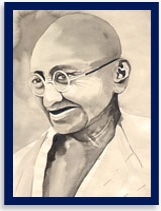
Subhash Chandra Bose was one of India's greatest freedom fighter. He was the
founder of the Indian National Army, popularly known as 'Azad Hind Fauj'.
Netaji Subhash Chandra Bose had visited London during pre-independence period
to discuss the future of India, with the members of the Labor party. His sudden
disappearance from Taiwan, led to surfacing of various theories, concerning the
possibilities of his survival.
Life of Subhash
Chandra Bose
Subhash Chandra Bose was born on 23 January, 1897 in Cuttack (Orissa) to
Janakinath Bose and Prabhavati Devi. Janakinath Bose was one of the successful
lawyer in Cuttack and received the title of "Rai Bahadur". He, later
became a member of the Bengal Legislative Council.
Subhash Chandra Bose was a very
intelligent and sincere student but never had much interest in sports. He
passed his B.A. in Philosophy from the Presidency College in Calcutta. He was
strongly influenced by Swami Vivekananda's teachings and was known for his
patriotic zeal as a student. He also adored Vivekananda as his spiritual Guru.
Start of the opposition
to British by Subhash Chandra Bose
Subhash Chandra Bose decided to take revenge, after reading so many incidents
about the exploitation of the fellow Indians by the British. In 1916, Subhash
reportedly beat and thrashed one of his British teachers E F Otten. The
professor made a racist remark against the Indian students. As a result,
Subhash Chandra Bose was expelled from the Presidency College and banished from
Calcutta University. The incident brought Subhash in the list of rebel-Indians.
In December 1921, Bose was arrested and imprisoned for organizing a boycott of
the celebrations to mark the Prince of Wales's visit to India.
Subhash Chandra Bose
in Britain for ICS and return to India
Subhash Chandra Bose's father wanted
him to become a civil servant and therefore, sent him to England to appear for
the Indian Civil Service Examination. Bose was placed fourth with highest marks
in English. But his urge for participating in the freedom movement was intense
that in April 1921, Bose resigned from the coveted Indian Civil Service and
came back to India. Soon, he left home to become an active member of India's independence
movement. He, later joined the Indian National Congress, and also elected as
the president of the party.
Subhash Chaandra Bose with Congress
Subhash Chandra Bose worked under the leadership of Chittaranjan Das, an active
member of Congress in Calcutta. It was Chittaranjan Das, who along with Motilal
Nehru, left Congress and founded the Swaraj Party in 1922. Subhash would regard
Chittaranjan Das as his political guru.
While Chittaranjan Das was busy in
developing the national strategy, Subhash Chandra Bose played a major role in
enlightening the students, youths and labors of Calcutta. He was eagerly
waiting to see India, as an independent, federal and republic nation.
Subhash Chandra Bose
Vs. Congress
In freedom struggle congress was large organisation. Subhash Chandra Bose
became a strong leader in Congress and he made brave attempt to mould the
entire party differently. Congress party was always lenient and never in a
position to oppose. Saubhashbabu outrightedly opposed this behaviour. This
opposition was against Gandhi‘s philosophy. Therefore Mahatma Gandhi and other
leaders were hurt and since then they opposed him.
Congress party had undertaken a deed
of opposing his every thoughts, insulting him and cut down his wings of high
flyer. In this manoeuvre of congress many of times he felt suffocated. Once
there was a picture of ‘Subhash Chandra Bose against entire congress party’. It
was first election of congress that time. Usually closer aide of Mahatma Gandhi
used to get elected; but this time Subhash Chandra Bose got elected with higher
votes. This insulted Gandhi group, which lead to their less interest of
thinking towards parties campaign for independence.
In order to acknowledge outside
support and get freedom he went till Germany, Japan when it was period of 2nd
world war! He decided to induce soldiers from outside to get freedom. Nehru at
that time said “If Subhash would bring soldiers from outside and
enter India, then I would be the first person to take sword in hand and oppose
him.” so much he disgust Subhash.
Formation of Azad
Hind Fauj by Subhash Chandra Bose
Netaji Subhash Chandra Bose was against rendering any kind of help to the
British during the World War II. He warned them so. The second World War broke
out in September of 1939, and just as predicted by Bose, India was declared as
a warring state (on behalf of the British) by the Governor General,
without consulting Indian leaders. The Congress party was in power in seven
major states and all state governments resigned in protest.
Subhash Chandra Bose now started a
mass movement against utilizing Indian resources and men for the great war. To
him, it made no sense to further bleed poor Indians for the sake of
colonial and imperial nations. There was a tremendous response to his
call and the British promptly imprisoned him . He took to a hunger-strike, and
after his health deteriorated on the 11th day of fasting, he was freed and was
placed under house arrest. The British could do nothing except locking him in
the prison.
It was in 1941, that Subhash Chandra
Bose suddenly disappeared. The authorities did not come to know for many days
that he was not in his Barrack (the house in which he was being guarded). He
traveled by foot, car and train and resurfaced in Kabul (now in Afghanistan),
only to disappear once again. In November 1941, his broadcast from German
radio sent shock waves amongst the British and electrified the Indian masses
who realized that their leader was working on a master plan to free their
motherland. It also gave fresh confidence to the revolutionaries in India who
were challenging the British in many ways.
The Axis powers (mainly Germany)
assured Netaji Subhash Chandra Bose military and other help to fight the
British. Japan by this time had grown into another strong world power,
occupying key colonies of Dutch, French, and British colonies in Asia. Netaji
Bose had struck alliance with Germany and Japan. He rightly felt that his
presence in the East would help his countrymen in freedom struggle and second
phase of his saga began. It is told that he was last seen on land near Kiel
canal in Germany, in the beginning of 1943. A most hazardous journey was
undertaken by him under water, covering thousands of miles, crossing
enemy territories. He was in the Atlantic, the Middle East, Madagascar and the
Indian ocean. Battles were being fought over land, in the air and there were
mines in the sea. At one stage he traveled 400 miles in a rubber dingy to reach
a Japanese submarine, which took him to Tokyo. He was warmly received in Japan
and was declared the head of the Indian army, which consisted of about
40,000 soldiers from Singapore and other eastern regions. These soldiers were
united by another great revolutionary Rash Behari Bose. Rash Behari handed over
them to Netaji Subhash Chandra Bose. Netaji Bose called it the Indian National
Army (INA) and a government by the name "Azad Hind Government"
was declared on the 21st of October 1943. INA freed the Andaman and Nicobar
islands from the British and were renamed as Swaraj and Shaheed islands. The
Government started functioning.
Subhash Chandra Bose wanted to free
India from the Eastern front. He had taken care that Japanese interference was
not present from any angle. Army leadership, administration and communications
were managed by Indians only. Subhash Brigade, Azad Brigade and Gandhi Brigade
were formed. INA marched through Burma and occupied Coxtown on the Indian Border.
A touching scene ensued when the solders entered their 'free' motherland. Some
lay down and kissed, some placed pieces of mother earth on their heads,
others wept. They were now inside India and were determined to drive out the
British! Delhi Chalo (Let's march to Delhi) was the war cry.
The bombing of Hiroshima and
Nagasaki changed the history of mankind. Japan had to surrender.
Effect of Netaji
Subhash Chandra Bose's earlier visits to England
During his sojourn to England, he met with the leaders of British Labor Party
and political thinkers including Clement Attlee, Arthur Greenwood, Harold
Laski, G.D.H. Cole, and Sir Stafford Cripps. Bose also discuss with them about
the future of India. It must also be noted that it was during the regime of the
Labor Party (1945-1951), with Attlee as the Prime Minister, that India gained
independence.
Disappearance of
Subhash Chandra Bose
Although it was believed that Netaji Subhash Chandra Bose died in a plane
crash, his body was never recovered. There have so many theories been put
forward regarding his abrupt desertion. The government of India set up a number
of committees to investigate the case and come out with truth.
In May 1956, the Shah Nawaz
Committee visited Japan to look into the situation of Bose's assumed death.
Citing their lack of political relations with Taiwan, the Centre, did not seek
for the assistance from their government. The reports of Justice Mukherjee
Commission, tabled in Parliament on 17 May, 2006 said, "Bose did not die
in the plane crash and the ashes at Renkoji temple are not his". However,
the findings were rejected by the government of India.